

Drugging the Undruggable
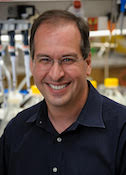
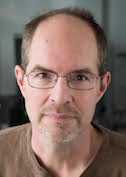
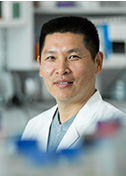
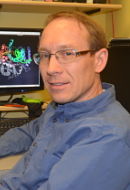
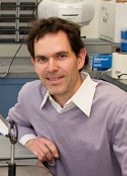
Dhirendra Simanshu
National Cancer Institute's RAS Initiative at Frederick National Laboratory for Cancer Research
Published June 29, 2026
Before fans packed stadiums for the 2026 World Cup, another crowd rose to its feet for a soccer ball of a different sort. But the standing ovation wasn't for a goal. Instead, it was for a drug aimed at KRAS, a soccer-ball-shaped protein whose mutations drive some of the most lethal and challenging cancers, showed an encouraging response in one-third of patients with advanced pancreatic cancer and nearly doubled median overall survival from 6.6 to 13.2 months.
For researchers like Dhirendra Simanshu, the results marked a long-sought clinical validation, but they also underscored the need for more effective and durable treatments. RAS-driven cancer cells still find ways to evade treatment through resistance mechanisms that Simanshu and his colleagues aim to minimize as they look for more effective and durable treatments for patients.
"KRAS was considered almost undruggable for 30 years," says Simanshu, who leads the structural biology group at the National Cancer Institute's RAS Initiative at Frederick National Laboratory for Cancer Research in Frederick, Maryland. "But over the last 10 years, things have started to change."

Simanshu joined the initiative in 2014, one year after it launched, as new experimental approaches and techniques were beginning to reshape the RAS field.
At the RAS Initiative, Simanshu and his colleagues have helped uncover molecular details that are contributing to the development of new generations of RAS-targeted therapies. In one of their first projects, Simanshu and his team determined the first full-length structure of KRAS. (PNAS, 2016) The structure captured the last 20 amino acids, an enigma to scientists for more than 30 years. These amino acids form a short, flexible tail that extends from the core of the soccer ball and helps anchor RAS to the cell membrane, allowing it to send signals that control cell growth.
His first glimpse of the full structure, from the first amino acid to the last, filled him with a sense of awe. "The feeling that what we're seeing on the computer screen is something nobody has ever seen before, and that it fills in a missing piece of KRAS biology, is incredibly exciting," Simanshu says. "That gives you goosebumps and a real sense of satisfaction."
Since then, his group has solved hundreds of structures that show how RAS functions, revealed previously unknown interactions with key signaling partners, and helped develop experimental drugs that are now being tested in patients.
Shredding the undruggable reputation
His team aims to fill in "the missing key structural information in RAS biology," he says. Those insights can inform the search for new inhibitors and help identify strategies to develop more durable treatments. In fact, just as the pancreatic cancer clinical trial results made headlines with evidence of dramatic but short-lived success, he and his colleagues were finishing a structural analysis of RAS drug-resistance mutations.
"The more we understand RAS biology, the more opportunities we have to target RAS-driven cancer from different angles," he says. "For example, if you have multiple drugs that target RAS in different ways, a resistance mutation may affect interaction with some drugs but not others."
Much of the work in Simanshu's group focuses on understanding how RAS communicates with the proteins that carry its signals deeper into the cell. RAS normally works as an on-off switch that activates multiple downstream signaling pathways. In healthy cells, it can turn itself off. When mutated, RAS keeps growth signaling permanently switched on. Until recently, RAS mutations had eluded efforts to find pharmaceutical inhibitors.
Simanshu's group has uncovered new details of how RAS interacts with two key signaling proteins, RAF and PI3Kalpha. They were the first major RAS effectors identified more than three decades ago. The RAF pathway is best known for driving cell proliferation, while the PI3K pathway helps cells survive, grow, and resist cell death. RAS-driven cancers often depend on both pathways simultaneously.
The first step of RAF activation involves binding to active RAS. A RAS-binding domain on RAF had been identified, but it had not provided a viable target for disrupting the RAS–RAF interaction. In a 2021 study, Simanshu's team and collaborators identified a second KRAS-binding site on RAF. The work was a collaboration with Frank McCormick at the University of California, San Francisco, and the scientific director of the RAS Initiative. The finding opened new avenues for efforts to develop drugs that disrupt the RAS–RAF interaction. (Nature Communications, 2021).
Breaking the glue that binds
Next, Simanshu and his colleagues turned to the problem of how KRAS binds to PI3Kalpha, the form of PI3K most strongly associated with human solid tumors.
"The problem for any structural biologist was that these two proteins do not bind very tightly, so whenever you try to crystallize them or solve their structure by cryoEM, they just fall apart," he says. Instead, they turned to some of the other RAS-like proteins in the human body. They found a couple of them that bound tightly enough to PI3K to crystallize and solved their structures. But that did not answer the KRAS question. (Nature Communications, 2025)
They learned about insulin-mimicking compounds being developed for diabetes treatment by Daiichi Sankyo in Japan through Frank McCormick, who consulted for the company. The compounds were eventually discontinued for diabetes, but not before researchers uncovered the mechanisms of action. Initial biochemical analysis by Daiichi Sankyo scientists showed that these compounds increased the interaction between RAS and PI3Kalpha.
Simanshu's team received the compound for biophysical and structural characterization after McCormick and Dwight Nissley, director of the Cancer Research Technology Program, which includes the RAS Initiative, helped establish a collaboration under a material transfer agreement (MTA).
"It was acting like a molecular glue," Simanshu says. "In mice, it helped maintain glucose levels. But because it also activated RAS-mediated PI3K signaling, it had undesirable effects."
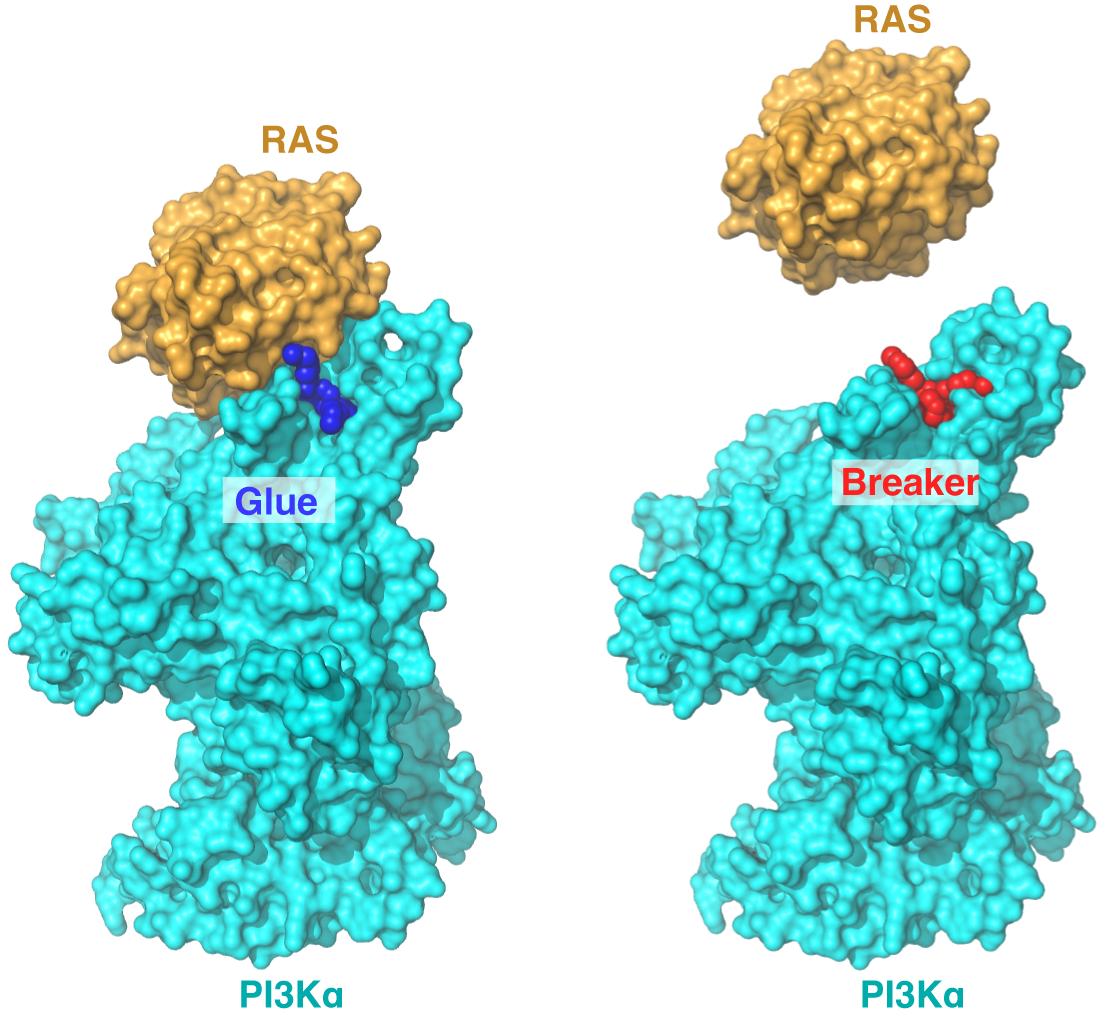
Using the molecular glue, Simanshu's team solved the structure, which became the first structure of the KRAS-PI3Kalpha complex and offered clues to its adhesive properties. The compound bound tightly to PI3Kalpha and stabilized its interaction with KRAS. A lightbulb went off for Simanshu. (Science, June 2025)
"I thought, instead of strengthening the interaction of PI3Kalpha with KRAS, what if we could make it unfavorable? Instead of acting as a glue, it could prevent interaction between PI3Kalpha and KRAS," he says. (Science, July 2025).
The clinical candidate, called BBO-10203, was developed in close collaboration with BridgeBio Oncology Therapeutics (BBOT) and Lawrence Livermore National Laboratory (LLNL). "We worked on this idea for five years, transforming a molecular glue into a molecular breaker that eventually became a clinical candidate," Simanshu says. The BREAKER-101 phase 1 clinical trial (NCT06625775) is enrolling adult patients with advanced solid tumors, such as metastatic breast, lung, and colorectal cancers, to assess its safety, tolerability, and antitumor activity.
Through structure-guided design, Simanshu's group also contributed to two other drug candidates developed by colleagues at the RAS Initiative in collaboration with BBOT and LLNL: BBO-8520, which targets the G12C mutation in KRAS, and BBO-11818, which targets multiple KRAS mutations. Both are designed to bind KRAS in its active (ON) and inactive (OFF) states and are currently being evaluated in Phase 1 clinical trials. (Cancer Discovery, 2025; Cancer Discovery, 2026)
The scientific journey
Simanshu grew up in eastern India. He was the first in his family to earn a PhD. Education was a family priority, he says, but in that part of the country, higher education usually meant medicine or engineering rather than laboratory research. He enrolled in a newly established national undergraduate program in biotechnology at St. Columba's College in his hometown, Hazaribagh.
After earning his bachelor's degree, he took the national entrance examination for a master's program in biotechnology, which led him to Jawaharlal Nehru University in New Delhi. Time in the laboratory inspired him to pursue a PhD at the Indian Institute of Science in Bangalore, where he trained in structural biology, focusing on crystallography in the laboratory of M.R.N. Murthy.
After his PhD, he headed to New York to join Dinshaw Patel's laboratory at Memorial Sloan Kettering Cancer Center (MSK), which was transitioning from NMR to crystallography. Rather than focusing on mastering another technique, he came to appreciate that answering important biological questions mattered more than the method itself. Over the next few years, he determined the structures of proteins that interact with DNA, RNA, and lipids, revealing how these interactions regulate key cellular processes.
In 2013, as he was looking ahead to start his own lab, several scientists who had been making notable contributions in RAS biology - McCormick, Kevan Shokat, and Steve Fesik - visited MSK as guest speakers. Their talks highlighted recent progress in the field and the growing possibility that RAS, long considered undruggable, could finally be targeted with drugs. Their presentations inspired Simanshu to pursue RAS research.
RAS was the first human oncogene identified more than 40 years ago, mutations in three versions of RAS proteins help drive an estimated 20% of all cancers. Of the three RAS proteins, KRAS became the dominant clinical story, because it is more commonly mutated - in 95% of pancreatic cancers, 45% of colorectal cancers, and 35% of lung cancers.
Simanshu learned about the new RAS Initiative being launched by NCI at the Frederick National Laboratory, just 45 miles northwest of Washington, DC, with McCormick at its helm. The initiative aimed to bring together researchers in the RAS field to drive innovation needed to develop targeted drugs.
Simanshu joined in fall 2014 to establish the initiative's structural biology program. As a bonus, Frederick was surrounded by parks and forests, as was his childhood home in India. He built the structural biology laboratory from scratch and set up the infrastructure for crystallography, which is well-suited to the small RAS protein, as well as NMR to study molecular dynamics. As the program grew, his team also incorporated cryo-electron microscopy (cryoEM) for studying larger protein complexes.
Simanshu first started using SBGrid during his postdoctoral training at MSK. Continuing with it was an easy decision when he established his own laboratory in 2014. "Its curated, regularly updated collection of structural biology software simplified day-to-day research," he says. More than 15 years later, it remains an integral part of his group's structural biology research.
The RAS Initiative brings together researchers with complementary expertise to accelerate the discovery of therapies for patients with RAS mutations, he says. About half a dozen groups focus on the singular task of finding therapies for patients with RAS mutations from different angles, combining structural biology, biophysical and cellular screening, medicinal and computational chemistry, biochemical and cell-based assays, informatics, and mass spectrometry-based proteomics. Like many long-term research programs, the initiative continues to adapt to changing priorities while maintaining its focus on developing therapies for patients with RAS-driven cancers.
Crystallography is the lab's mainstay. Compounds are first screened using biochemical or cellular assays and then structurally characterized to understand how they interact with RAS. During the glue-to-breaker drug discovery program, the team solved more than 100 crystal structures, working their way from an initial glue into the clinical candidate BBO-10203, to guide the design of improved compounds.
Simanshu's group is also exploring new approaches to target RAS. One involves crystallography-based fragment screening at the Diamond Light Source in the United Kingdom, where thousands of KRAS mutant crystals are soaked with one small chemical fragment at a time to identify those that bind to the protein. At the same time, the team is investigating ways to harness the cell's own quality-control machinery through a protein called LZTR1 to redirect mutant RAS proteins for degradation, offering a fundamentally different strategy for targeting RAS-driven cancers. (Science, 2025).
"Drug discovery is a highly collaborative and iterative process," he says. "Structural biology is one piece of the puzzle. Every advance comes from scientists across different disciplines working together to make compounds better and safer until they're ready for the clinic. When you finally see encouraging results in patients, there's a real sense of satisfaction knowing that all those small advances can make a difference in people's lives."
---By Carol Cruzan Morton
Carol Cruzan Morton is a senior science writer and medical editor in Oregon. She contributes profiles to SBGrid and has also written for Science,
Medscape, Oregonian, Boston Globe, and San Francisco Chronicle, among other publications.